Overview
Soils are home to the most complex and ecologically diverse communities on Earth. In a single gram of soil, there billions of organisms! While we can see some of these organisms like worms and certain insects, most of soil life is made of microorganisms too small to see with out a microscope. These microbes include bacteria and fungi as well as archaea (single-celled, similar in size to bacteria but often found in extreme environments) and protists (mostly single-celled).
The term “microbiome” refers to the collection of all the microbes present in a given habitat (i.e., microbiota) and their genetic material (i.e., genes and DNA). In agricultural systems, there are many unique microbiomes including soil microbiomes, plant-associated microbiomes, and water or air microbiomes. These microbiomes can differ in the number of organisms and the structure or composition of the community.
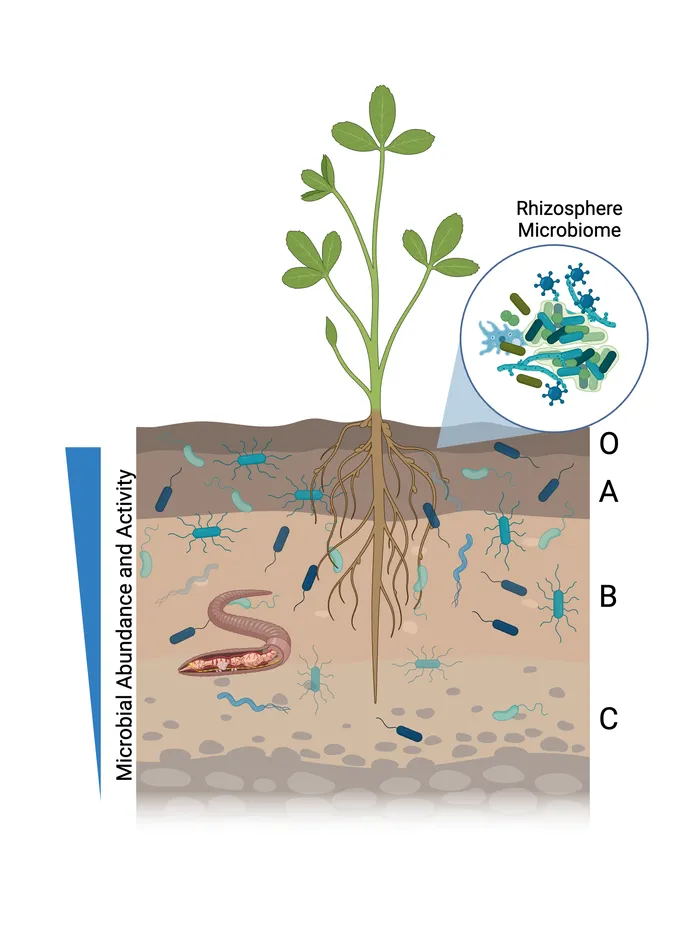
For instance, agroforestry soil microbiomes can differ from cropping system soil microbiome both in terms of the specific microbial species present but also the abundances of these populations. For soils, some characteristics are very strong determinants of what microbes are present. These include pH, organic carbon quantity and quality, and moisture. Other characteristics, such as temperature or the presence of different plant species, are less important. Within soil there distinct microbial habitats, with the highest microbial abundance and activity typically in the top 10 cm. The rhizosphere, or the region of soil directly surrounding plant roots, is another hotspot of microbial activity.
Soil microbiomes carry out many important biological functions in agricultural systems that support and maintain healthy soil and productive crops.
Soil Microbiome Function
- Decomposition: Microbes break down dead organic matter (e.g., crop residues, insect carcasses), returning carbon, nitrogen, and other nutrients into the soil. For instance, certain bacteria and fungi can degrade cellulose, which is present in plant cells and the most abundant organic molecule on Earth. These nutrients are either incorporated into living cells, incorporated into dead cells or microbial necromass, or respired as gas. Living and dead microbes typically contribute 1-4% of total soil carbon and 2-6% of total soil nitrogen.
- Nutrient Cycling: Microbes mediate global biogeochemical cycles of essential soil and plant nutrients including carbon, nitrogen, and phosphorus. To illustrate, some soil and plant-associated microbes (e.g., rhizobia living in legume roots) fix atmospheric nitrogen. Other microbes mediate the transformation of nitrogen between organic and inorganic nutrients through a process called nitrification. Finally, other microbes are responsible for denitrification, which involves the release of soil nitrogen back into the atmosphere in the form of N2O. Different microbial communities carry out these processes at different rates.
- Greenhouse Gas (GHG) Emissions and Climate Regulation: Microbes play a pivotal role in the decomposition of deceased organic matter and the utilization of carbon from root exudates. During these processes, carbon and nitrogen can either remain stored in the soil or be released back into the atmosphere as CO2, N2O, or CH4. Microbes regulate the movement of carbon between the soil and the atmosphere. When this carbon is protected from microbial activity, it becomes sequestered within the soil thereby increasing soil carbon content. This presents a significant opportunity for agricultural soils to act as carbon sinks, effectively capturing and storing atmospheric carbon which can help mitigate climate change.
- Soil Structure and Water Retention: Many microbes are capable of producing extracellular polymeric substances (EPS), biofilms, and other “sticky” secretions. These substances serve to bind together soil particles with microbial cells, forming soil microaggregates and macroaggregates. Soil aggregates play a pivotal role in enhancing soil structure and promoting better water infiltration. Furthermore, the substances excreted by these microbes have the added benefit of retaining water, thereby improving water-holding capacity.
- Plant Growth Promotion: Microbes establish symbiotic relationships with plants that are vital for plant growth and yield. Many of these partnerships involve nitrogen or phosphorus nutrient exchanges. Certain microbes can produce growth-regulating phytohormones like auxin, gibberellin, and cytokinin, further contributing to plant development. Microbes also provide enhanced stress tolerance to crops, enabling them to withstand challenging environmental conditions such as salt, drought, and heat.
- Disease Suppression: While some pathogenic microbes can indeed cause diseases, the overwhelming majority of microbes are either beneficial or have a neutral impact. Microbes contribute to disease suppression through both direct and indirect mechanisms. Directly, they can produce biocidal compounds, including antibiotics and antifungal agents, which hinder the growth of harmful pathogens. Alternatively, microbes can indirectly combat disease by outcompeting potential pathogens, preventing them from establishing in the soil or colonizing plant roots. These processes are responsible for disease-suppressive soils.